The Missing Degree: A Thanksgiving Card, a Blank Oven Setting, and Four Test Pies
When I pulled the recipe tin out on November 10, 2026, I was not looking for a mystery. I was looking for pumpkin pie. What I found was an index card in my grandmother's handwriting, listing every ingredient with the confidence of a woman who had made this pie since the Eisenhower administration, and then, at the bottom, four words: Bake at ???. No temperature. No time. Just a blank that has been quietly complicating my November for six years.
This is the kind of problem The SMQH Files was built for: not a crisis, exactly, but a small domestic irregularity that refuses to close. So I treated the card as evidence. I made test pies. I called relatives. I compared church cookbooks. I did not fully solve it. I got closer. That may be the most Thanksgiving outcome available.
The Evidence on the Card
The card is not pristine. It has a grease crescent near the sugar line and a corner softened by decades of being tucked into the same tin. The filling recipe is ordinary and specific: two eggs, one can of pumpkin, one cup of sugar, half a teaspoon of salt, cinnamon, ginger, cloves, and a can of evaporated milk. Unbaked shell. The instructions are where things fall apart. After the filling steps, the card says Bake at and then nothing. Underneath, in a different ink and a shakier hand, someone added until knife comes clean. That is not a temperature. That is a hope.
I checked the back of the card. Nothing. I held it up to the lamp. No faint pencil ghost of a number. I asked my mother if she remembered anyone erasing it. She said no, then paused, then said, Well, she never used a recipe anyway. That is the first clue and also the first dead end. A woman who did not need the card may not have needed the number.
Four Pies, Four Alibis
I decided to test the blank rather than argue with it. Same filling, same brand of frozen shell, same oven, four temperatures. This was not a laboratory. It was a Tuesday night with too many dishes in the sink, but it was close enough for domestic forensics.
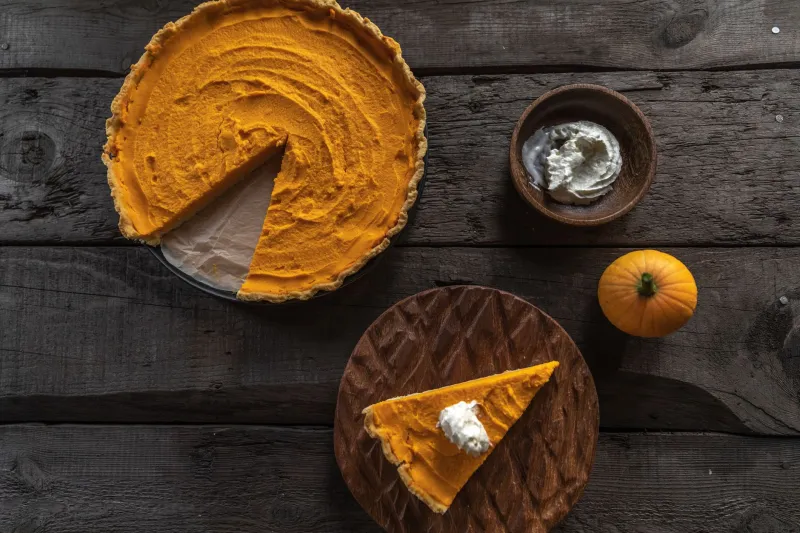
At 325°F, the pie set slowly and stayed pale. It took nearly seventy minutes to lose its jiggle, and the texture came out soft, almost flan-like. Good, but not the pie I remembered. At 350°F, the middle was still loose at fifty minutes and set at about sixty. The flavor was right. The surface was a little dull. At 375°F, the edges set cleanly, the center had a small controlled wobble at forty-five minutes, and a knife came out nearly clean at fifty-two. That was the closest match to memory: custard firm but not rubbery, spices clear, crust browned without turning bitter. At 400°F, the pie puffed, cracked across the top, and developed a darker rim than anyone in my family would call traditional.
If the card assumed a moderate oven, 375°F is the closest thing to a confession. If it assumed a slow oven, 325°F is the alibi. The blank does not choose. It just sits there.
The Family Phone Tree
I called four relatives and got four versions of the same uncertainty. My mother said 350°F, then admitted she always watches the pie instead of the clock. Aunt Denise said moderate, and when pressed, said 350 or 375, who knows. Cousin Mark said 400°F for fifteen minutes and then 350°F for the rest, which is a real technique but not one written on the card. My uncle thought she used a countertop oven that ran hot and that the real temperature was anybody's guess.
No two answers matched, but nobody was lying. They were remembering a habit, not a number. That distinction matters. A recipe card is often treated like a control panel, but family cards are more like notes to self. The missing temperature may simply be the thing my grandmother did not think needed saying, the way you do not write down how to tie your shoes.
The Cookbook Witnesses
I pulled three vintage community cookbooks off the shelf: a 1974 Methodist spiral-bound, a 1981 extension-service collection, and an undated church fundraiser book with a cover held together by packing tape. All three had pumpkin pie recipes. One said 425°F for fifteen minutes, then 350°F for forty. Another said 350°F for one hour. A third said moderate oven and left it at that.
That was the useful part. The blank on our card is not unique. It belongs to a era of cooking when moderate oven was a real instruction, not a cop-out. Home ovens ran unevenly. Cooks learned their own appliances. A number might have seemed less reliable than a look, a shake, or a knife test. The missing temperature is probably not a family quirk. It is a lost convention, plus a healthy dose of never meant to be exact.
The Verdict, Such as It Is
I now bake the pie at 375°F for about forty-five to fifty-five minutes, rotating once, and I pull it when the center still has a slight wobble. That is not what the card says. The card says nothing. But it gets me to a pie that tastes like the one I remember, and in this house that counts as evidence.
The case is not closed. The card still refuses to give a temperature, and I still check it every November as if the blank might have changed. It has not. What changed is how I read it. The missing number is not a hole in the recipe. It is a reminder that some instructions live in hands, ovens, and memory, and that a card can be complete without being exact.
Filed under Domestic Forensics. Case status: half-solved, still delicious.