One Dial, One Voice: A $5 Radio and the Case for Accidental Loyalty
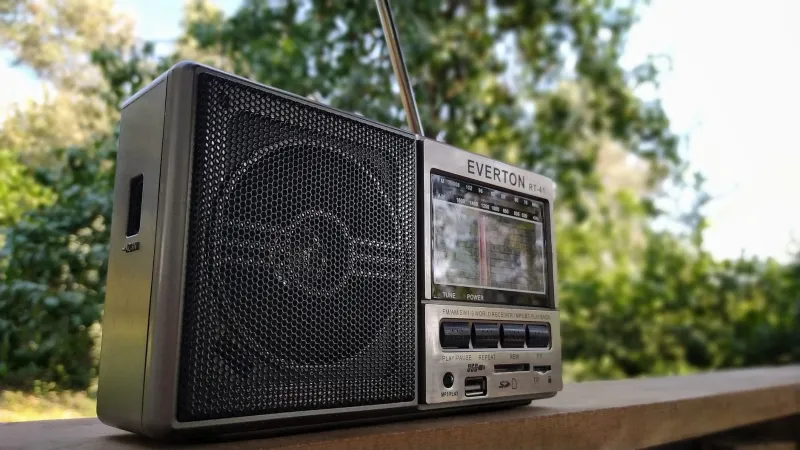
The radio came home in a cardboard box that smelled like a basement. Five dollars, cash, no receipt, no backstory beyond a handwritten index card that said “works.” That card was technically true. The radio works. It just works for one station.
I found it at an estate sale in September 2026, tucked between a fondue set and a stack of VHS tapes labeled in a handwriting I will never decode. It is a wood-grain tabletop model, the kind that looks like it should be playing a ballgame in a den with orange carpet. The dial is analog, the speaker is cloth, and the back panel has a diagram of tubes that may or may not still exist inside. I paid the five dollars because it was five dollars, and because I have a filing cabinet in my head labeled “things that might be interesting later.”
Evidence Bag No. 7
At home, I plugged it in on the kitchen counter. The pilot light came on. The speaker popped once, then settled into that low electrical hum that old appliances make when they are thinking. I turned the tuning knob slowly across the AM band. Nothing. Static, a wheeze, more static. Then, around the middle of the dial, a voice arrived.
It was a distant AM station, roughly sixty miles away by my rough math and questionable map skills. The signal was not clean. It was the kind of reception that sounds like someone talking through a blanket held by a second person who is also tired. But it was there. A weather report, a commercial for a tractor dealership, a song I did not recognize. I turned the knob past it. Static. I turned back. The station returned.
I tried the FM band. Silence. Not static — silence, which is somehow worse. I tried the shortwave switch, if that is what it was. Nothing. I tried the other knob, the one that does something I have not identified. The station stayed.
The Bench Test, Such As It Was
My first theory was simple: the antenna was bad. The radio has a built-in ferrite bar and a telescoping whip that extends to about half its advertised length. I extended it fully. No change. I draped a length of speaker wire from the antenna terminal to a curtain rod. No change. I connected the wire to a metal bookshelf. The station got slightly louder, which felt like a victory until I realized the bookshelf was also slightly closer to the window.
I moved the radio to the living room. The station followed. I moved it to the bedroom. It followed again. I moved it to the basement, where the old-house wiring is at its most theatrical. The station followed, but now with a faint buzz underneath, like the broadcast was being performed in a room with a fluorescent light.
This is the part where a more disciplined person would consult a schematic. I consulted the internet, which is like consulting a schematic written by a thousand people who have never met your radio. I learned about ground loops, loop antennas, RF chokes, and the fact that old houses can turn wiring into accidental antennas. I learned that “front-end overload” is a real phrase and not a description of my Saturday. I learned that AM reception depends on things I cannot see and would not enjoy measuring.
The Old-House Variable
Our house was built in the 1940s, which means its wiring has been amended more times than a city council ordinance. There is a ground rod somewhere. There is also a mystery switch in the hallway that controls nothing and has been painted over twice. The radio does not care about any of this. It receives its one station in every room, on every outlet, with or without the antenna wire.
That consistency is what makes the case strange. A broken tuner would drift. A bad antenna would vary. A haunted radio would probably be more dramatic — maybe a voice from 1953 reading grain prices, maybe a station that does not exist anymore. This is not that. This is a radio that has decided on one station and is sticking with it. It is not haunted. It is loyal.
I tested the loyalty hypothesis by leaving it on for an entire afternoon. The station played music, ads, a call-in segment about a road closure, and something that may have been a church service or a school board meeting. The reception never improved. The reception never failed. At one point I moved the radio six inches to the left and the signal went from “distant” to “slightly less distant.” I moved it back. It returned to its default state.
The Case Against Fixing It
There is a version of this story where I take the radio to a repair shop and a patient man in a visor tells me the IF transformer is shot or the tuning capacitor has a dead spot. There is a version where I pay more than five dollars to restore full AM and FM reception and then never listen to it again. I have lived enough of that version to recognize it.
Because here is the thing about half-broken objects: they are often more interesting than fixed ones. A fully functional radio is a appliance. A radio that receives exactly one station is a conversation piece, a small mystery, a thing with a personality. It has preferences. It has a routine. It has, in some sense, a relationship with a distant transmitter that I will never fully understand.
The SMQH Files has a long history with unfinished business, and I am aware that this could become another entry in that ledger. But I am not sure this one needs finishing. The radio works well enough to be useful. It works poorly enough to be interesting. That is a rare ratio.
Status: Open, By Choice
I have filed this under Domestic Forensics, evidence bag No. 7, status open. The radio sits on the kitchen counter next to a bowl of keys and a plant that is doing its best. Every few days I turn it on. The same station comes through, slightly fuzzy, slightly stubborn, reporting on a world that is not quite mine. I do not know its call letters. I do not know why it is the only one. I have stopped trying to find out.
Accidental loyalty is a strange thing. You do not choose it. You just keep showing up, and one day the static clears enough to hear a voice, and you decide that is the voice you are going to listen to. The radio made that decision for me. I am leaving it alone.